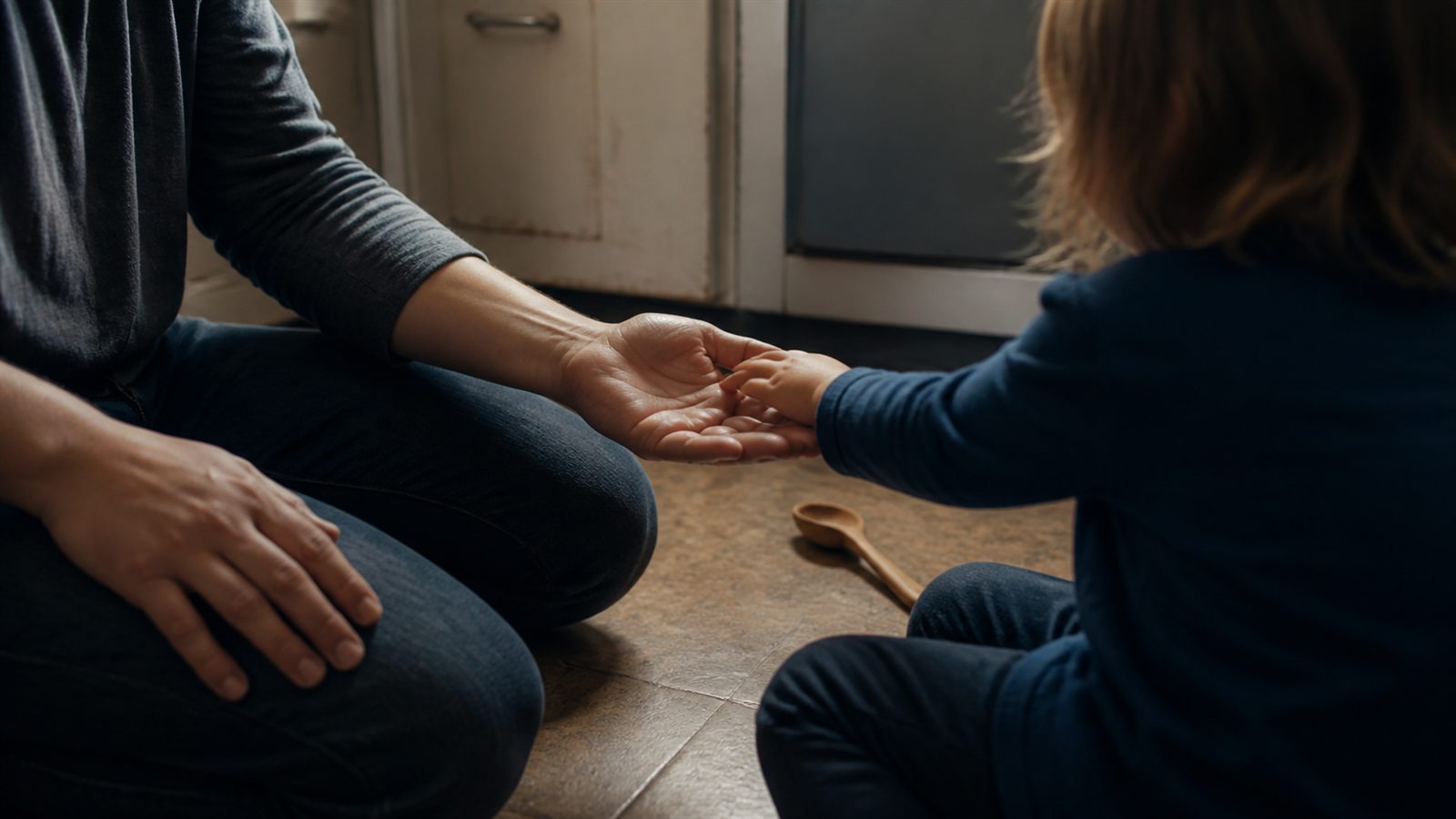
You recognize the old phrase while it is still leaving your mouth. Interrupting a pattern means taking responsibility, understanding what your child can manage, and making repair visible in what happens next.
By Isabella Becker · 12 min read
English editorial edition of Isabella Becker’s Portuguese essay, translated and adapted for international readers. The article presents Virtology’s interpretation; its specific theoretical mechanisms should be distinguished from independently established clinical findings.
There were seven words, and you recognized them halfway through the sentence.
Not only their meaning. The rhythm. The pause before the last one. The way you lowered your chin. For an instant, you heard your grandmother in an old kitchen, speaking through your voice on a Tuesday evening to a six-year-old who is now looking at you.
You stopped. So did the child.
Many parents make a private promise that things will be different for their children. Then, under pressure, an old phrase or gesture appears. The recognition can bring shame as well as alarm.
It does not establish that you lack love or that repetition is inevitable. It does identify a response for which you are now responsible, and a moment in which something different can begin.
The source describes familiar situations: the end of a tiring day, the rush before school, a child's fear that seems unreasonable, or a protest that happens in front of other people.
Perhaps the crying is especially difficult because your own tears were unwelcome. Perhaps public disagreement makes you feel exposed before you can notice what the child needs. Perhaps the demand is simply arriving when you have very little support left.
Later, in bed, you promise that it will never happen again. The promise is sincere. Without a practical alternative or help with the conditions, the same response may remain the easiest one to reach.
These scenes have several possible influences: learned habits, stress, temperament, current health, a child's needs and the environment around the family. They should not all be reduced to an unhealed childhood wound.
The useful question is what keeps making this response likely, and what would make another response more available.
What remains unexamined can enter the relationship
Eduardo Casarotto's Virtology interprets some repetition as the return of experiences a person has not yet been able to understand or handle differently.
In that account, intimacy and fatigue can reveal an old protective pattern. You respond as though the present situation requires the same strategy that once kept you safe, accepted or in control.
That is a lens for inquiry, not a law that everyone passes on only what they have not healed. Parents with difficult histories can offer loving care, and a harmful response can occur without one identifiable past event explaining it.
The practical value is to create a second question alongside “What is my child doing?”: “What is happening in me as I respond?”
The second question never removes the first responsibility. A child does not have to understand an adult's history before deserving safety and respectful guidance.
What this age is being asked to do
Virtology calls a central developmental experience a mandate. The source gives examples such as basic trust early in life, growing autonomy, comparison during the school years and identity in adolescence.
These are parts of the author's developmental map. They should not be confused with Evolution Bands, which belong to a different dimension of the framework.
The question for a parent is whether an expectation fits the particular child's emerging abilities and circumstances. Can the child follow this instruction? Do they need help identifying a feeling, waiting, shifting attention or resolving a conflict?
Development is gradual and variable. A young child can begin learning emotional regulation and perspective-taking with support; it would be inaccurate to say that a three-year-old has no capacity for either because the necessary brain structures simply do not exist.
The aim is to guide what is developing, rather than demand adult consistency from a child. The CDC provides age-related parenting resources that emphasize nurturing, protecting and guiding children. CDC positive parenting resources
When an expectation becomes humiliation
The original uses forceful language for the harm of demanding an ability before a child can reliably provide it. Its concern is the movement from teaching a skill to making the child feel fundamentally insufficient.
“Stop being ridiculous” does not explain how to manage fear. “You should know better” may conceal that the child needs help doing what they partly understand. A demand for immediate calm can add another threat to a situation already overwhelming.
This does not mean parents should abandon limits. You can stop hitting while acknowledging anger. You can maintain a bedtime while helping with the disappointment. The feeling can be accepted while a behavior is redirected.
The difference is whether guidance offers a next step or only a verdict on the child.
A useful question after a difficult moment is: “What did I expect them to do, and what support would make that more possible next time?”
Three descriptions of experience, and a separate question of timing
The source distinguishes experiences that were well lived, not lived and painfully or poorly lived.
In its framework, a well-lived experience becomes a resource. It need not have been easy; support and integration matter. A not-lived experience concerns an opportunity that was missing. A painfully lived experience concerns something encountered without adequate protection or ways of responding.
These are reflective descriptions, not three exhaustive clinical outcomes. Absence can itself be harmful, and a missing opportunity does not prove that a particular capacity is wholly absent from the brain.
Timing is a separate question. An experience can arrive when a person has fewer resources to manage it, or become available later than expected. Later learning is not merely an inferior repair, and developmental maps should not become rigid deadlines.
The source illustrates competing demands with becoming a parent around twenty: caring for a child may coexist with a wish for exploration, education or independence. That tension is possible at many ages. It does not mean a young parent is neurologically unfit, or that love and a wish for other experiences cannot coexist.
The useful inquiry concerns support and opportunities, not judging a family by the age at which it began.
A map should open possibilities
The source explicitly says that its developmental descriptions concern tendencies, not destinies. Temperament, supportive relationships, material conditions and later experiences can change what becomes possible.
Use that qualification as part of the model, not an afterthought. You cannot diagnose a four-year-old's future from a difficult phase or conclude that your own history has permanently closed a door.
A child who struggled with a transition may need a different kind of support. A parent who missed something important can seek learning and connection now. Progress does not require pretending that the earlier difficulty did not matter.
The map earns its usefulness when it helps identify an actual next step. It becomes less useful when it transforms a life into a timetable of failures.
The family places adults help create
Virtology also describes family positions through the image of chairs: the chosen child, an ally, or someone who experiences exclusion.
The important shift in responsibility is toward the adults' behavior and expectations. Children do not earn unequal dignity, nor are they responsible for managing adult alliances.
The specific account of an instinctive distribution of positions is the author's hypothesis, not an established brain mechanism or something every family must contain. Differences between siblings can have many influences, and appropriate care may vary with age or need.
Still, the image asks a concrete question of a parent: have I begun to treat one child as the easy one, the difficult one, the one who understands me, or the one who must never disappoint?
Notice the behavior that follows the label. Who gets asked about their day? Whose distress is minimized? Who is expected to take sides? A conscious change can begin with those ordinary patterns, without assigning each child a permanent role.
When a child's freedom touches something painful
A child who cries freely may bring you into contact with the tears you learned to hide. A child who asks directly may unsettle someone who learned that needing anything was dangerous.
The source suggests two possible layers: an old emotional association becomes active, and the child's permission to express something makes your own earlier restriction more visible.
This can be a revealing hypothesis. It is not the explanation of every strong reaction. Noise, overload, illness and immediate pressures also matter, and a parent does not need to uncover a hidden wound before seeking practical help.
If the pattern fits, try naming it privately: “Their crying is making me feel that something unacceptable is happening. The crying itself may simply mean they need help.”
That observation can create a little space. It does not require the child to stop having a feeling so that you can examine yours.
What attachment research makes hopeful
Research has found associations between parents' attachment representations and their children's attachment relationships. The transmission is not complete, and findings vary with populations and circumstances. It would be too strong to say that narrative coherence alone determines the bond or that actual childhood experiences do not matter. Verhage and colleagues' synthesis
The literature also discusses earned security: accounts of security despite reported adversity. Research into that idea raises methodological questions as well as possibilities for change. It should not become a certificate that someone has fully resolved their past. Roisman and colleagues
The hopeful implication is that a difficult beginning does not make a good relationship with your child impossible. Present support, reflection and responsive care can matter.
The source's emphasis on telling a more coherent story is useful when it allows complexity: recognizing what happened without either idealizing it or making it the sole explanation of everything that follows.
Understanding is different from explaining away
The original challenges a familiar shortcut: “They did the best they could, so I should stop being hurt.”
That sentence may express a perspective someone has freely reached. Imposed too early, it can also silence a real experience. Understanding a caregiver's circumstances does not require declaring their behavior acceptable.
Virtology emphasizes acknowledging the experience and developing ways to respond differently. Its image is of changing the reader of the memory rather than erasing the history.
That is a metaphor. Memory is reconstructive, and helpful changes in meaning do not inherently deny facts. The relevant distinction is between a perspective that expands understanding and a forced positive account that leaves no room for pain.
You may be able to say both: “My parent faced difficult circumstances,” and “What happened to me needed protection that I did not receive.” Neither statement makes the child responsible for the adult.
Seeking what was missing without making the child supply it
The source suggests that unmet developmental opportunities may reappear as unusually intense expectations of a child.
A parent who could not study may experience a school mark as an existential event. Someone who lacked freedom may become excessively restrictive or struggle to set any limits. A person who missed play may feel compelled to provide endless toys or become unusually impatient with playfulness.
These are illustrations, not reliable tests of hidden history. A similar behavior can have several causes.
Where the connection is meaningful, ask what belongs to your own life now. Could you return to learning, seek a supportive relationship, make room for an interest or explore the issue with a professional?
Your child does not need to succeed, behave perfectly or appreciate your sacrifices in order to repair what you missed. Developing something for yourself can reduce the pressure placed on their experience.
Repair belongs in the pattern of care
Research on early interaction describes ordinary mismatches and attempts to reconnect. Care is not a state of uninterrupted synchrony. Tronick and colleagues' discussion
This does not prove that repair alone determines attachment, that repeated harmful behavior is harmless if followed by an apology, or that children benefit from adults deliberately making mistakes.
It supports a more realistic aim: notice when the interaction has gone wrong, respond to the child's experience and change what happens next.
An apology can be simple. “I shouted. That was not a good way to speak to you. I am going to take a pause before we try again.” You can still address the original behavior afterwards, without making it the cause of your loss of control.
Do not ask the child to comfort you, forgive immediately or reassure you that you are a good parent. Repair gives responsibility back to the adult and makes safety more predictable through action.
What changes before the next difficult moment
A promise becomes more credible when it has a practical plan behind it.
Notice the recurring conditions. Is the morning rushed because too much is being attempted? Is a transition difficult for the child? Is there a way to prepare earlier, reduce stimulation or ask another adult for support?
If you need to pause, ensure that a young child remains safely supervised. Leaving a room is not automatically the right response in every situation. Sometimes you can step back while staying present; sometimes another safe adult can take over.
For repeated shouting, harshness or fear of losing control, professional or parenting support can help develop alternatives. The National Child Traumatic Stress Network offers a resource for parents coping with their own trauma histories. Parenting in the wake of past trauma
Getting support is part of protecting the relationship, not proof that you should have been fully healed before becoming a parent.
Repair today, reflect when you have space
A brief repair and a weekly review serve different purposes.
Once you are calm enough and the child is safe, name what you did without attaching blame: “I shouted at you.”
Take responsibility: “Your behavior was something we needed to handle, but shouting was my response to change.” Adapt the words to the child's age.
Name one realistic action: “Next time I will ask for a pause and make sure you are safe while I calm down.” Follow through, and allow the child their own response.
Once a week, note a few difficult moments. What happened, what did you expect, and what support was missing for either of you?
Ask whether the reaction reminds you of an earlier experience, without forcing an age or memory. Also ask whether the expectation fit your child's actual abilities.
If you are afraid you may physically harm a child, prioritize immediate safety, involve a safe adult if available and seek urgent professional or emergency support. Do not wait for another episode to see whether reflection is enough.
Parenting beyond performance and rank
The link to God Bless America lies in how value is assigned. Casarotto's Structural Americanism examines a wider logic of competition, status and external confirmation.
That logic can enter family life when a child's performance becomes evidence of an adult's success, or when obedience is treated as proof that the adult deserves respect.
Virtology's invitation is to examine the organization beneath the reaction: can guidance protect a child's development without making belonging depend on winning, pleasing or never failing?