Understand the pattern
Connect human needs, personality and the demands of the surrounding environment.
 Alchemy of VirtuesIN PARTNERSHIP WITH INSTITUTO VIRTUDES← God Bless America
HUMAN DEVELOPMENT · PERSONALITY · STRUCTURE
An ambitious new proposition for mental health and human development.
How do we move from understanding a pattern to being able to change it? Eduardo Casarotto brings personality, human needs, neuroscience and the development of virtues into one theoretical project.
English translation in progress. Translation materials available on request.
01 / THE PROPOSITION
A person can understand a painful pattern and still repeat it.
This is the opening challenge in Casarotto’s framework. Virtology proposes that human development requires more than explanation: it requires building dispositions that remain available in real situations.
Connect human needs, personality and the demands of the surrounding environment.
Specify what a person needs to learn, then bring that learning into repeated experience and reflection.
Examine how institutions reward, constrain or sustain the patterns a person is trying to change.
The ambition is an integrated contribution to mental health and human development: a theory of functioning, a vocabulary of capacities and a structured route into practice.
This is the author’s proposed contribution. The theoretical comparison and field experience described in the books do not establish clinical superiority over other approaches. The framework’s distinctive mechanisms and outcomes call for independent empirical evaluation.
02 / THE EXPANDED WORK
The expanded Portuguese manuscript of Foundations of Virtology spans 2,035 pages, bringing the framework, its proposed mechanisms and its applications into a substantially expanded work.
The work comprises 106 chapters, followed by a neuroscientific dictionary, index and general references.
This is the wider intellectual work behind the concepts used in God Bless America: how human needs, personality, learned defenses and cultural structures interact.
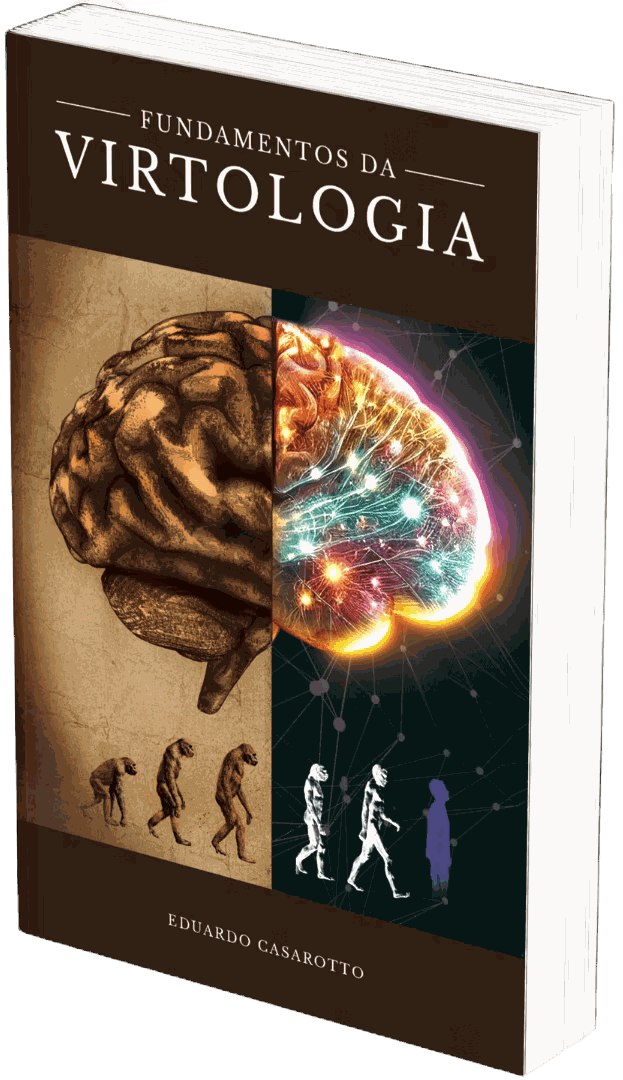
Figures refer to the expanded Portuguese manuscript. The cover shown belongs to an earlier edition. English translation is in progress; translation materials are available on request.
03 / THE STARTING POINT
The opening chapter asks what capacity must be built, and through what process.
A person may identify the origin of a pattern, name its consequences and recognize its return. Casarotto asks why that understanding can coexist with the repetition of the same response when pressure rises.
Virtology is presented as a theoretical and clinical framework for examining the whole person. Its layers connect needs, personality, psychic organization, levels of development and the dispositions through which behavior changes.
The author places virtues at the center of this architecture. In his terminology, a virtue is a trained disposition available in action, including when circumstances make it difficult to act on it.
04 / THE ARCHITECTURE
Human needs and the forces that give behavior direction. The framework organizes needs into five groups, from survival to transcendence.
Psychic organization and personality: the internal processes through which people encounter and interpret events.
The author’s seven developmental levels describe degrees of psychological organization. They are distinguished from intelligence, education and social achievement.
Casarotto’s concepts of pride and self-interest organize his account of patterns concerned with relative position, recognition and the needs of others.
The Law of Flow and the author’s wider account of life connect motivation, interpretation, personality and the conditions within which a person acts.
Thirty-three virtues form the practice dimension. The book describes their proposed mechanisms, exercises and criteria for observing progress.
05 / 51 HUMAN NEEDS
Casarotto distinguishes a human need from the cultural form through which we try to satisfy it.
In his framework, 51 needs are organized into five groups. A need for connection, for example, can become attached to recognition, consumption or an image of success. This is one point where the theory of the person meets the cultural inquiry in God Bless America.
The demands of survival, safety and significance.
The felt experience of life and connection with others.
Learning, individuality and the growth of capacity.
Purpose, contribution and a relationship with the wider world.
Moving beyond a life organized around the separate self.
Classification from Foundations of Virtology. The groups are part of the author’s framework; this overview is not a diagnostic assessment.
06 / THE COMPARISON
Chapter 2 sets out the author’s case for Virtology as an integrated theoretical framework.
Casarotto uses the evaluative framework presented in Theories of Personality by Feist, Roberts and Feist. He compares approaches by their conception of the person, their theoretical quality and the contributions he identifies in each school.
Freud · Adler · Jung · Klein · Horney · Erikson · Fromm
Maslow · Rogers · May
Allport · McCrae and Costa · Eysenck · Buss
Skinner · Bandura · Rotter and Mischel · Kelly
Research generation · Falsifiability · Organization of knowledge · Guidance for action · Internal consistency · Parsimony
The chapter argues for an integration of psychodynamics, human needs, dispositional structure, biological foundations and social learning. It distinguishes a comparison of theoretical architecture from the amount of independent evidence accumulated by each school, and discusses complexity as a challenge for the framework.
07 / ORIGINS OF THE 33
Across traditions, a shared question: what helps a human being develop?
Casarotto describes a comparative inquiry into religious traditions, seeking the practices and dispositions they hold in common. He identifies 33 virtues as the shared vocabulary at the heart of his approach.
Virtology then asks how these dispositions can become available in ordinary life: in a disagreement, under criticism, in a position of authority or when another person needs help.
The conceptual move is from a teaching someone can repeat to a capacity they can exercise. In this framework, a virtue is a learned disposition that can guide a response under pressure; it is not a label for judging someone’s moral worth.
The approximate figure is reported in the author’s Fundamentos manuscript. The Institute’s public account describes comparative work across dozens of named traditions. The complete research corpus and the extent of agreement remain matters for scholarly examination.
08 / SNO & SNE
CASAROTTO’S UNIFYING THESIS
In Virtology, Casarotto proposes that the many forms of neurotic defense share two underlying roots: the need to secure importance and approval, and the priority given to one’s own survival and needs. SNO and SNE are his neurofunctional formulation of that thesis.
Neurofunctional System of Pride
In the author’s account, belonging to a group becomes linked to survival, and importance becomes a way of securing acceptance. When a person’s sense of safety depends on recognition or position, criticism and exclusion can be experienced as threats.
Comparison, control, domination, retaliation and the constant search for approval are, in his model, different expressions of this same protective calculation.
Neurofunctional System of Selfishness
Casarotto describes a second survival calculation: protecting the self by prioritizing its needs and resources over those of others. When that priority becomes rigid, the other person’s needs lose weight in the response.
In his model, indifference, inflexibility and the use of others for personal advantage can express this common organizing pattern.
Different defenses can protect the same underlying demand.
In Foundations of Virtology, Casarotto develops a unifying account: temperament and life history shape the form of a defense, while pride and selfishness supply its underlying organizing demands. Casarotto describes the resulting defensive patterns as character armor. The same need for importance, for example, can appear as overt dominance or as withdrawal from situations where rejection is feared.
His proposed response works at that underlying level. Humility develops a sense of worth less dependent on position and approval; selflessness gives the other person’s needs a place in the response. The wider program of 33 virtues is intended to develop capacities that can replace rigid defensive patterns.
Structural Americanism examines a cultural order that can reward rank, superiority and self-interest. The two-root thesis is the author’s bridge from that social order to the inner patterns through which people absorb and reproduce it.
“All neuroses” expresses the scope of Casarotto’s thesis, using “neurosis” in his theoretical vocabulary. It is not a claim that all mental illness is caused by moral failings. SNO and SNE are proposed distributed systems; the universal claim and its specific mechanisms require independent empirical testing. Appropriate professional care remains essential where indicated.
09 / EVOLUTION BANDS
What if the capacity to choose a different response changes with a person’s mode of functioning?
Casarotto’s seven Faixas de Evolução — Evolution Bands — describe a proposed continuum of human functioning. The framework relates patterns of reactivity, awareness and consideration for others to the capacities a person can draw on in a situation.
Development as movement.
Freedom as a capacity.
The bands are described as continuous and reversible functional states. They are not fixed identities, measures of intelligence or rankings of human worth.
In the author’s argument, freedom is partly a developmental question: which responses can a person actually sustain when pressure rises? This makes the model relevant to the book’s inquiry into conformity, status and inherited social expectations.
English renderings of the seven names in the revised Fundamentos manuscript. This is an introduction to the author’s theoretical map, not a diagnostic scale or a validated clinical classification.
10 / LEARNING & THE BRAIN
From knowing an idea to being able to use it.
Casarotto draws on research into learning, memory and neuroplasticity to ask how repeated experience may help consolidate a new response. The opening chapter brings this literature into dialogue with the problem of durable personal change.
Support for learning and neuroplasticity does not by itself validate every mechanism or clinical claim in Virtology. The manuscript distinguishes broader scientific findings from the author’s own formulations.
11 / FREEDOM AND DEVELOPMENT
Casarotto describes freedom of action as something that grows with the person’s psychological organization.
In the argument of Chapter 2, the capacity to choose is a variable of the individual. The framework asks what a person is able to sustain at a particular level of development, then connects that question with the dispositions to be practiced.
This provides a point of connection with God Bless America: a cultural expectation may be understood intellectually while continuing to shape how recognition, belonging and success are experienced.
12 / LEARNING AND PRACTICE
The book connects its account of change with learning, memory, repetition and application in real situations.
The framework asks what moves the person, how they interpret events and what their recurring response accomplishes.
The question then becomes which disposition would allow a different response and how the author’s framework describes its development.
The practical program links repeated study and reflection with action in daily life. The companion Manual provides an organized route through the virtues.
This describes the author’s theoretical proposal. The revised manuscript distinguishes established research on learning from Virtology’s own formulations and questions for investigation.
13 / WHO IT IS FOR
The opening chapters address readers in mental health, education and prison practice, as well as researchers interested in examining the proposed framework.
The book provides a deeper account of the concepts behind structural Americanism: needs, personality, internalized authority, development and the relationship between a person and their environment.
RETURN TO THE CENTRAL BOOK
God Bless America examines how a cultural model becomes internalized through institutions, identity and desire. Foundations of Virtology develops the account of human functioning that informs that analysis.
Explore structural Americanism →FURTHER READING & AVAILABILITY
The expanded Portuguese work spans more than 2,000 pages and over 100 chapters. Its current manuscript contains 2,035 pages and 106 chapters, followed by reference material. The cover shown belongs to an earlier Portuguese edition. English translation is in progress, and materials are available on request.
The English translation is in progress. Translation materials can be requested for discussion or editorial consideration.
Foundations develops the theoretical architecture and its intellectual context. The Manual organizes a practical route through the 33 virtues.
It is Casarotto’s own comparative argument, using criteria from a personality-theory textbook. The chapter explicitly distinguishes theoretical integration from accumulated independent research.
The author presents the work as complementary to appropriate care. Reading this presentation does not replace diagnosis, psychotherapy, psychiatric care or medical treatment.
Contact Isabella Becker, International Director of Instituto Virtudes, at contato@alquimiadasvirtudes.com or WhatsApp +49 163 9643336, to discuss English editions and evaluation materials. Full manuscripts are shared privately by arrangement.
Foundations of Virtology (Fundamentos da Virtologia), by Eduardo Casarotto. The expanded Portuguese manuscript spans 2,035 pages and 106 chapters, followed by a neuroscientific dictionary, index and general references. English pagination will depend on translation and typesetting. The image shows the cover of an earlier Portuguese edition. English translation in progress; materials available on request.
Original institute catalogue (Portuguese; may describe an earlier edition) ↗