Understand the system
Humanization, the author’s five filters, organizational development and the relationship between human behavior and institutional rules.
 Alchemy of VirtuesIN PARTNERSHIP WITH INSTITUTO VIRTUDES← God Bless America
INSTITUTIONS · GOVERNANCE · HUMAN DIGNITY
Humanization 2.0 — designing institutions around human needs.
A rule determines what happens long after a speech has ended. Eduardo Casarotto places institutional rules, responsibilities and everyday procedures at the center of his approach to humanization.
English-language materials can be discussed on request.
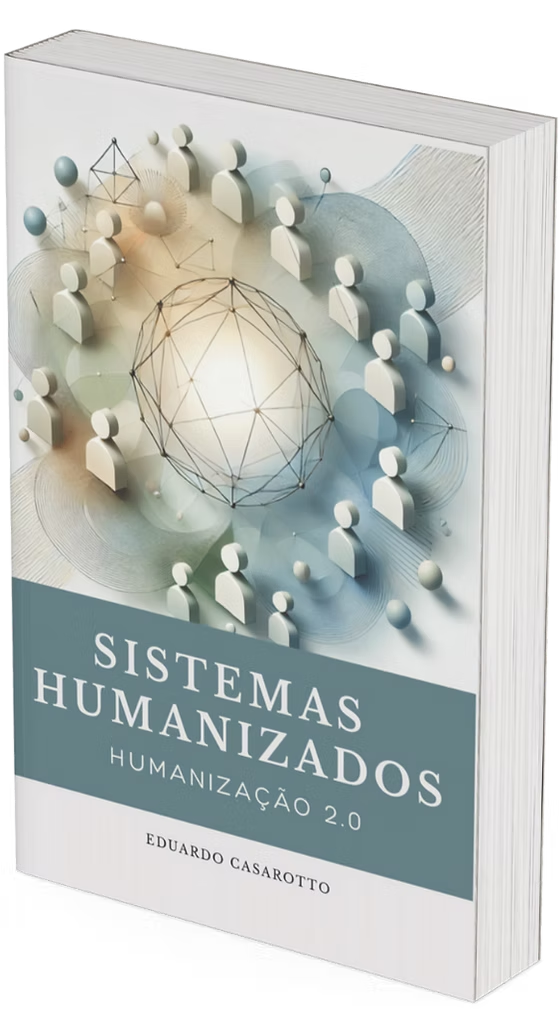
01 / THE IDEA
The everyday experience of an institution is shaped by what its rules permit, reward and require.
A workplace may speak about dignity while its procedures send another message. In Casarotto’s account, the practical task is to examine that relationship: what happens when a worker makes a mistake, needs support, receives feedback or challenges a decision?
Humanization 2.0 brings those questions into governance. Written policies, responsibilities and procedures become places where the organization can examine how its declared values operate in practice.
The book extends the author’s work on personal development to the environments in which people act. It gives the institutional dimension of his wider project a practical form.
02 / PEOPLE & MENTAL HEALTH
What happens when an institution keeps producing the pressures a person is trying to overcome?
Humanized Systems extends the project of Virtology into organizational life. It asks how rules, leadership and everyday procedures can support dignity, participation and the recognition of human needs.
This gives the three works a shared direction: God Bless America examines a cultural structure, Foundations of Virtology develops a theory of human functioning, and Humanized Systems brings the institutional environment into the response.
03 / INSIDE THE BOOK
Humanization, the author’s five filters, organizational development and the relationship between human behavior and institutional rules.
Governance and human resources, from roles and recruitment to development, appraisal, benefits and departure procedures.
Workplace mental health, feedback, service, inclusion and the internal structures that sustain humanization.
04 / WORKING TOOLS
Eight components of the methodology.
05 / IN PRACTICE
The author distinguishes the responsibilities of a role from the idea that a person’s position gives them greater human worth. Leadership becomes a question about how responsibility is exercised.
Written rules and an internal commission give the institution a way to examine whether its approach continues when individual leaders change.
Feedback, service and internal procedures bring institutional expectations into forms that people can discuss, apply and review.
These are explanatory connections drawn from Casarotto’s institutional teaching, rather than a report of measured results in a particular organization.
06 / INTERNATIONAL RELEVANCE
Psychological health, psychosocial risk and the design of work provide international points of connection for the book.
OSHA’s workplace-stress guidance and NIOSH’s Total Worker Health approach address working conditions and prevention.
OSHA guidance ↗NIOSH approach ↗EU-OSHA identifies psychosocial risk management as part of employers’ duties under Framework Directive 89/391/EEC. National implementation varies.
EU-OSHA overview ↗Employers must assess and act on work-related stress risks. HSE’s Management Standards provide an approach to this task.
HSE guidance ↗Guidelines for managing psychosocial risks within occupational health and safety management. ISO standards are voluntary and national law takes precedence.
ISO 45003 ↗ · Standards and national law ↗The Portuguese offer includes three hours of lessons about Brazil’s NR-1. The references above provide international context; they do not establish equivalence, certification, endorsement or legal compliance for the methodology.
07 / WHO IT IS FOR
Leaders, managers and human resources professionals can examine the connection between their responsibilities, the rules they work with and the experience of the people affected by them.
Educators, consultants and professionals working with organizations can use the book to explore Casarotto’s account of institutional humanization. Its scope includes companies, public institutions, schools, hospitals and prisons.
RETURN TO THE CENTRAL BOOK
God Bless America examines how cultural structures reproduce patterns of power. Humanized Systems develops the institutional side of the response: how an organization can change the rules through which people encounter authority, expectations and one another.
Explore structural Americanism →FURTHER READING & AVAILABILITY
The Portuguese publisher describes Humanized Systems as accessible on its own. Foundations of Virtology provides the wider theoretical background.
The institutional question also applies to education, healthcare, public services and prison settings: how do written rules shape human experience?
No. Compliance depends on the relevant jurisdiction, implementation and appropriate professional assessment. The book presents the author’s methodology.
The source offer describes Portuguese lessons about Brazilian regulation. English-language evaluation materials and translation arrangements should be discussed when requesting information.
It provides the institutional dimension of Casarotto’s wider project. God Bless America analyzes structural Americanism; Humanized Systems explores how the environments that organize everyday conduct can be changed.
Contact Isabella Becker, International Director of Instituto Virtudes, at contato@alquimiadasvirtudes.com or WhatsApp +49 163 9643336, to discuss English editions and evaluation materials. Full manuscripts are shared privately by arrangement.
English editorial adaptation of the official Portuguese presentation, supplemented by the author’s institutional teaching and official international references. The cover and edition figures refer to the Portuguese book.
Original institute catalogue (Portuguese; may describe an earlier edition) ↗